
The working day is over, yet your mind is still occupied by an unanswered email and tomorrow’s appointments. On your way home, you reach for your smartphone almost automatically.
There is plenty competing for your attention – but little that offers a genuine change of pace.
Learning the saxophone in Berlin can give your evenings a new direction.
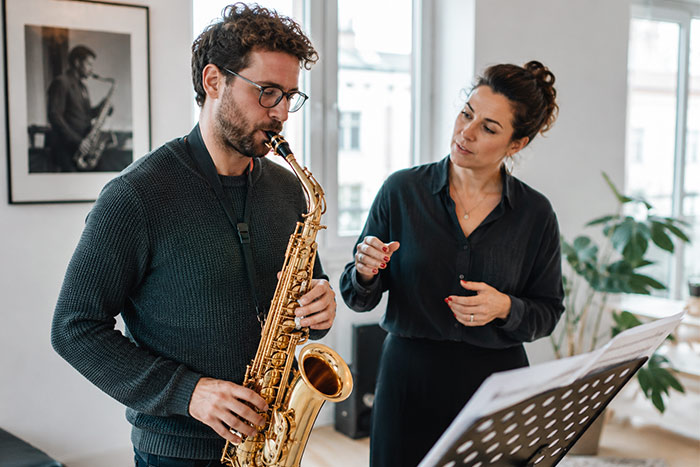
You assemble the instrument, place your fingers on the keys and focus on producing a steady note.
For a moment, the music takes centre stage: a sound, a short melody, a musical idea.
For adults, this can be just as appealing as making music itself: a regular opportunity to step back from everyday life and devote time to an activity that brings joy and personal fulfilment.

A Different Kind of Focus
During the working day, we often switch between different tasks within the space of a few minutes.
When playing the saxophone, by contrast, you remain focused on one thing and take the time to understand it more fully.
Even a simple melody requires attentive listening.
Does the note sound cleanly? Does the rhythm remain steady?
Where should you breathe so that the musical phrase sounds natural?
Questions like these give your attention a clear focus.
A passage that initially seemed unfamiliar becomes more natural with each repetition as you increasingly recognise what matters.
Of course, not every practice session will feel relaxing.
Learning requires patience, and some days will be more productive than others.
Even so, engaging with a musical task can offer a welcome break from the thoughts that have occupied you throughout the day.

Why Adults Love the Saxophone
The saxophone has a particularly expressive sound.
In a ballad, it can sound warm and understated; in a pop song, bright and rhythmic; and in classical music, gentle and lyrical.
This versatility gives adult beginners plenty of scope to discover their musical preferences.
Perhaps you are inspired by a jazz recording, a familiar film theme or a song that has stayed with you for years.
When you play music that means something to you personally, technical exercises also gain a clear purpose.
The direct connection between your playing and the result you hear is especially rewarding.
Breath control, embouchure – the way your lips and the mouthpiece work together – and finger movements all combine to shape the sound.
The better these elements work together, the more clearly individual notes become a musical statement.
You do not need an ambitious performance goal to achieve this.
Playing even a short melody with a beautiful sound is an achievement worth celebrating.

Breathing, Posture and Comfortable Playing
Breathing plays a central role in saxophone playing.
However, a good sound does not come from blowing into the instrument as forcefully as possible.
As a beginner, you learn to breathe in naturally and release the air in a controlled, even flow.
You will also discover how posture, mouthpiece position and unnecessary tension can affect your playing.
Your teacher will help you adjust the neck strap correctly, find a comfortable playing position and avoid applying excessive pressure to the mouthpiece.
These practical foundations make it easier to focus on the music.
The aim is to develop a technique that allows you to play the instrument with as little effort as possible.
If you arrive at your lesson after a demanding day with raised shoulders or a tense jaw, it can be helpful to become aware of these habits and gradually release the tension as you play.

Getting Started Without Putting Yourself Under Pressure
For many adults, deciding to take their first lesson is more difficult than the lesson itself.
In your professional life, you are probably accustomed to handling tasks confidently and competently.
It can therefore feel unfamiliar to play an uneven note, lose your place in the music or have to ask how to read a rhythm.
But all of this is part of learning.
An uneven sound is an opportunity to listen more closely and try something different.
It says nothing about whether you are musical.
Progress is easier to recognise when you focus on specific changes.
Perhaps you can now hold a note steadily, move between two fingerings without hesitation or play a melody through to the end without stopping.
Taking the time to recognise achievements like these helps preserve the enjoyment of making music.
A new interest need not become yet another task at which you constantly expect yourself to excel.
Practising the Saxophone in Everyday Berlin Life
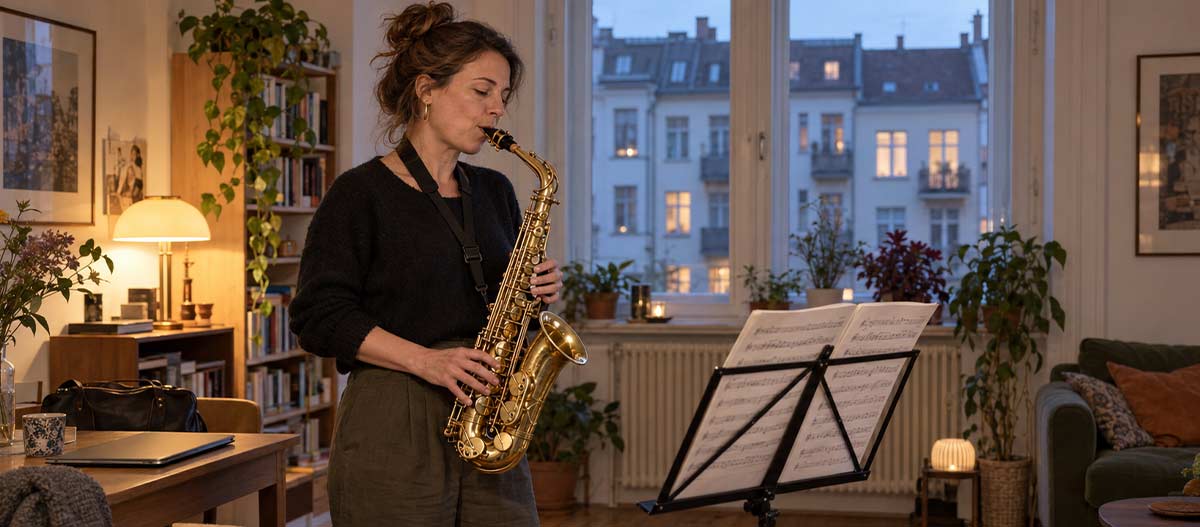
A musical routine should fit your actual weekly schedule.
If commuting, family commitments and changing working hours shape your daily life, it may be difficult to maintain an extensive practice schedule.
Short, focused sessions are often a more practical way to begin.
You might start by playing sustained, even notes for a few minutes, then repeat a fingering exercise from your lesson and finish with a melody you enjoy.
Your teacher will help you tailor the length and content of your practice sessions to your current level.
Your living situation also plays a part.
The saxophone is an acoustic instrument and remains audible even when played quietly.
Agree suitable practice times with those around you, observe the relevant house rules and consider using a rehearsal room if practising at home proves difficult.
Some musical preparation can also be done without playing aloud.
You can read through rhythms, listen closely to a recording or examine the structure of a piece.
These activities also help prepare you for your next practice session with the instrument.

Discovering Berlin’s Music with Fresh Ears
Learning the saxophone often leads you to listen to music more attentively.
A solo that once sounded like an uninterrupted stream of notes suddenly reveals its details: a recurring motif, a deliberately placed pause or a change in articulation.
You begin to notice how a phrase is shaped and how much expression can be conveyed in just a few notes.
In a city with a music scene as diverse as Berlin’s, this opens up new perspectives.
A concert or recording can become both a source of enjoyment and inspiration.
You certainly do not need to understand everything you hear.
Sometimes an interesting musical turn is enough to give you a question to bring to your next lesson.
How One-to-One Tuition Provides Direction
People learning on their own are often unsure what to practise next or why a particular passage is causing difficulty.
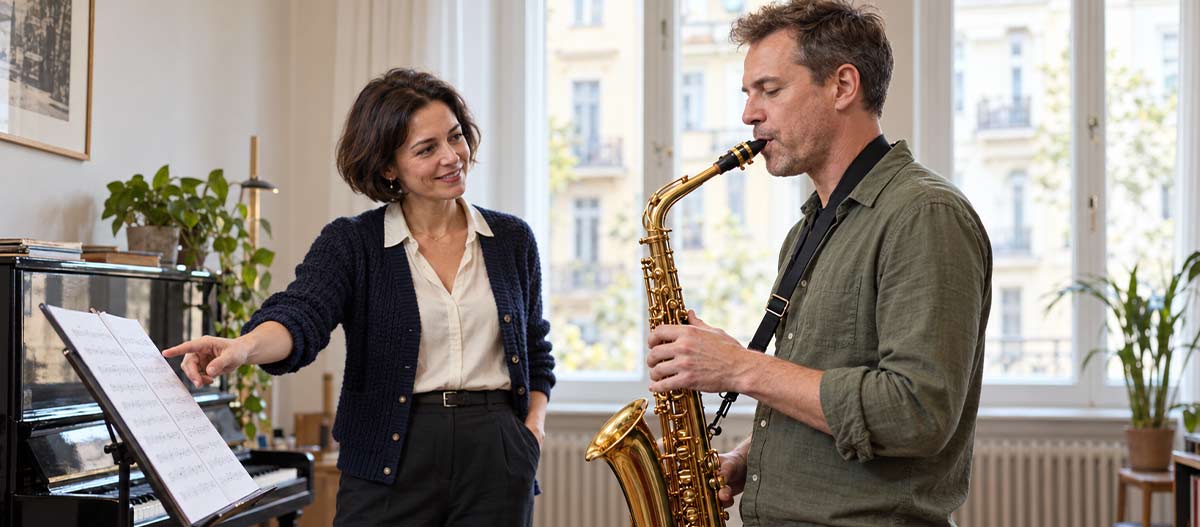
Individual saxophone lessons provide space to address precisely these questions.
An experienced teacher can identify whether the cause is an unfamiliar playing technique, an unsuitable reed or a problem with the instrument.
This prevents you from repeatedly getting stuck at the same point during practice.
Regular lessons also provide structure and accountability.
Even during a busy week, music retains a firm place in your schedule, and you know what to work on before your next lesson.
At the Dolce Musik Institut, saxophone lessons for adults in Berlin are tailored to your previous experience, interests and personal goals.
Beginners and returning players can develop their abilities through one-to-one tuition while keeping the enjoyment of making music at the heart of their learning.

Make Music Part of Your Week
You do not need to wait until life becomes less busy before you start playing the saxophone.
A realistic practice routine and a supportive teacher can help you make room for music alongside your existing commitments.
On some evenings, you will improve a difficult passage.
On others, after a long day, you will simply enjoy playing a familiar melody.
Both are good reasons to open the instrument case.
Discover saxophone lessons for adults at the Dolce Music Institute in Berlin and take the first step towards making music a regular part of your week.